PrePad Energy Software Company Eying U.S. Markets
Sean Hervo had always wanted to be an inventor. He also had known since his teens that he wanted to be an engineer.
“I never in a million years thought I would be a CEO of a software company,” says the co-founder of PrePad. The Calgary-based tech company provides cloud-based software for drilling and completions time and cost estimation.
After three and a half years in development, including deployments with some of the industry’s most innovative operators, the product is now ready for prime time, Hervo said in a recent interview.
PrePad recently raised US$2.8 million in seed funding as it establishes a new market category for drilling and completions software. The capital will provide the resources to enhance its product development, such as making it more user-friendly, and to accelerate its expansion into the U.S. market.
“There are no limits to our expansion in North America and we want to earn our right to be the industry standard solution in this new kind of category that we're creating here,” he said.
As a mechanical engineering student at the University of Manitoba, Hervo knew little about the oil and gas business. However, after meeting a Shell representative on campus, he decided to take his final engineering internship in Calgary with the company “just to see what this city is all about and see what this energy business — specifically oil and gas — is all about.”
Hervo never looked back.
He joined Shell Canada in 2009, riding the boom in unconventional shale oil and gas plays. He spent nearly 12 years there, including positions as strategic supply chain lead and completions manager for Canada, working on ways to innovate and improve the system.
“It was kind of living the problem, understanding that there was hopefully a better way to do it, not knowing how to build the solution for it.”
At Shell, Hervo was part of an internal team working on what was called the Integrated Systems Model, a precursor to PrePad. When Shell offered voluntary severances in 2021, he decided to take the leap to pursue further development of the project on his own, which Shell supported.
As the company pulled back from unconventional resources, “I felt it would die within Shell if it just stayed there and I knew this solution would be valuable to other unconventional operators,” said Hervo. “I got Shell’s approval to rebuild and commercialize this technology for the wider market with my business partner.”
That co-founder was Brandon Eidson, a fellow Shell employee and PrePad president and CPO (chief product officer). A PhD in electrical engineering and “algorithm wizard,” Eidson built PrePad’s proprietary simulation engine which enables the platform’s ability to model real-world economic tradeoffs under complex, constrained scenarios. He worked at Shell TechWorks in Boston, an innovative think tank that helps solve problems for Shell around the world.
“One of the problems was: ‘I'm this engineer in Canada trying to figure out how to work smarter, not harder, with all this cumbersome, clunky bottoms-up, cost and time estimating,” said Hervo. “Doing those estimates takes our engineers tons of time.”
How the well is constructed also will affect its flow and production rates.
“So not only do I want to just drive my cost lower but I also want to be cognizant of what's happening with well performance,” he said. “If we could integrate some of those different workflows together, that would be fantastic.”
Mobile manufacturing plant approach
PrePad has taken what Hervo calls a “mobile manufacturing plant of unconventional resource development” approach to optimizing the economics of well manufacturing, specifically drilling and completions. And that's crucial as investors are demanding not only volume growth but profitable growth.
Companies are spending $110 billion a year just in North America “smashing steel, water and sand in the ground for drilling and hydraulic fracturing,” Hervo noted. The challenge is how to extract the resource in the most efficient way possible for the balance sheet and completions are at the heart of it, he said.
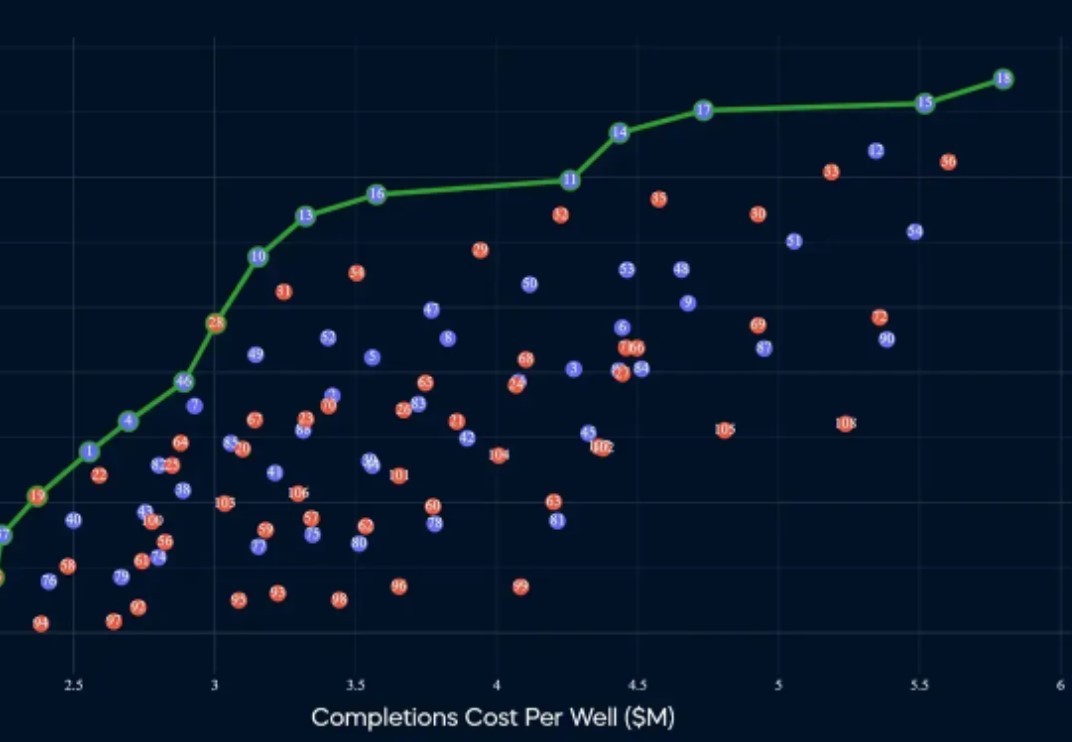
PrePad enables operators to manage the full capital life cycle — from concept to execution — by more rapidly simulating cost and time implications at every decision point.
It also can optimize execution by simulating cost, time, and design trade-offs under real-world constraints and can optimize asset development strategies before capital is committed, adjusting for market variabilities.
“You have the same tool that you're using for your detailed cost estimates, your business plan and budget, your forecast, and now you can use it for these design simulations too,” said Hervo.
Software as a Service model
Under the company’s core business SaaS (Software as a Service) subscription model, PrePad clients license and subscribe to access the software. “And we teach our clients to be super users and extract a ton of value with PrePad.”
The company is continually improving the product and PrePad evolves with best practices and customer feedback, he said. “We’re able to up everybody's game by allowing our users to access best practices like simul-frac, re-frac. U-laterals and ultra-long laterals.”
In addition to Devon Energy, Coterra Energy and Chevron, PrePad’s Canadian clients include Birchcliff Energy, Shell Canada, and Teine Energy.
With a cross-functional team of about a dozen and a growing headcount, PrePad has prioritized depth over size, said Hervo. For example, Kohl Meister, chief technology officer, “really brings the true software development chops to the table and helped us make it an enterprise grade type of software product.”
And while the company’s goal has been to establish first mover advantage and leadership position in its category, it also has been thoughtful when it comes to raising money, having seen other start-ups that have lost that advantage. He said it chose not to seek full venture funding “so we can maintain control and be nimble.”
“That’s why we’ve been thoughtful about who we bring on as investors and why we have a true advisory board we actively lean on.”
The board includes experienced software founders who have built technology for energy companies out of Calgary and successfully grown their businesses into the U.S. market, said Hervo.
To date, PrePad has raised US$3.7 million. Devon, the company’s first client, served as a strategic lead investor for the recent seed investment alongside contributions from strategic angel investors such as Deane Stewart and Dan Magyar, both formerly with 3esi-Enersight (now Quorum Software), and strategic partners such as Arcurve, a technology advisory and software development company.
Non-dilutive funding came from Alberta Innovates, Chevron Technology Ventures, the Business Development Bank of Canada (BDC), and the National Research Council of Canada’s Industrial Research Assistance Program (NRC IRAP).
In addition, PrePad received non-dilutive funding through its selection for Chevron Technology Ventures’ Catalyst Program, which can help further validate and commercialize its technology.