Insights With MEG Deal Complete, Cenovus Ready To Execute Plan
Cenovus Energy Inc. closed the acquisition of MEG Energy Corp. in November, ending a months-long public battle with Strathcona Resources Ltd. for ownership of its SAGD assets.
The company is now positioned to advance plans it laid out in August to increase production at the MEG assets from current levels of approximately 110,000 bbls/d to 150,000 bbls/d by 2028.
Cenovus also plans to capture annual run rate synergies of around $150 million in the 2026-2027 timeframe, increasing to $400 million in 2028 and beyond.
“The fit is exceptional and it plays right into what we do best, which is optimizing value from SAGD operations over all time frames,” said president and chief executive officer Jon McKenzie when he announced the company’s takeover bid last summer.
The majority of synergies will come from improved development and operating processes implemented over the next three years, said McKenzie.
MEG launched a multi-year $450 million facility expansion project to add up to 25,000 bbls/d of new productive capacity in early 2025, with the goal of taking total production up to 135,000 bbls/d in 2027.
Cenovus plans to spend around $400 million above MEG’s existing budget over the next two years to get to 150,000 bbls/d, while also lowering steam oil ratios (SOR) below two.
It expects to add 30,000 bbls/d of steam capacity by re-rating existing generators, which will add the 15,000 bbls/d to reach its 2028 target production.
SORs at MEG’s asset averaged slightly under 2.4 from the beginning of 2024 to September 2025, above Cenovus’s Christina Lake operations which averaged under 2.1. Foster Creek averaged around 2.3 in the same period.
Source: DOB Energy Oilsands Navigator
While MEG has been a low cost operator, Cenovus has some room to bring down operating costs to similar levels at its Christina Lake operation. Over the last four years, MEG’s operating costs, fuel included, have averaged $9.61/bbl while Cenovus Christina Lake has averaged $8.84/bbl. Foster Creek averaged $11.13/bbl over the same period
Source: Evaluate Energy Documents
Optimization plans should lower F&D costs
Cenovus also has plans to optimize future development on the MEG assets.
It expects to increase well spacing from 50 to 100 metres on the acquired assets, while extending average lateral lengths to 1,500 metres.
It also has also identified 250 potential redevelopment opportunities to leverage existing steam chambers, with costs around one-fifth of adding a new SAGD pair.
Together, this optimization is expected to lower future F&D costs by approximately $2/bbl, he said.
Source: Evaluate Energy Documents
Potential for future reserve additions
The MEG assets added slightly under two billion bbls of proved and probable reserves, with a reserve life index of over 50 years at current production rates.
But it also creates an opportunity to develop previously inaccessible resources, and convert them into reserves.
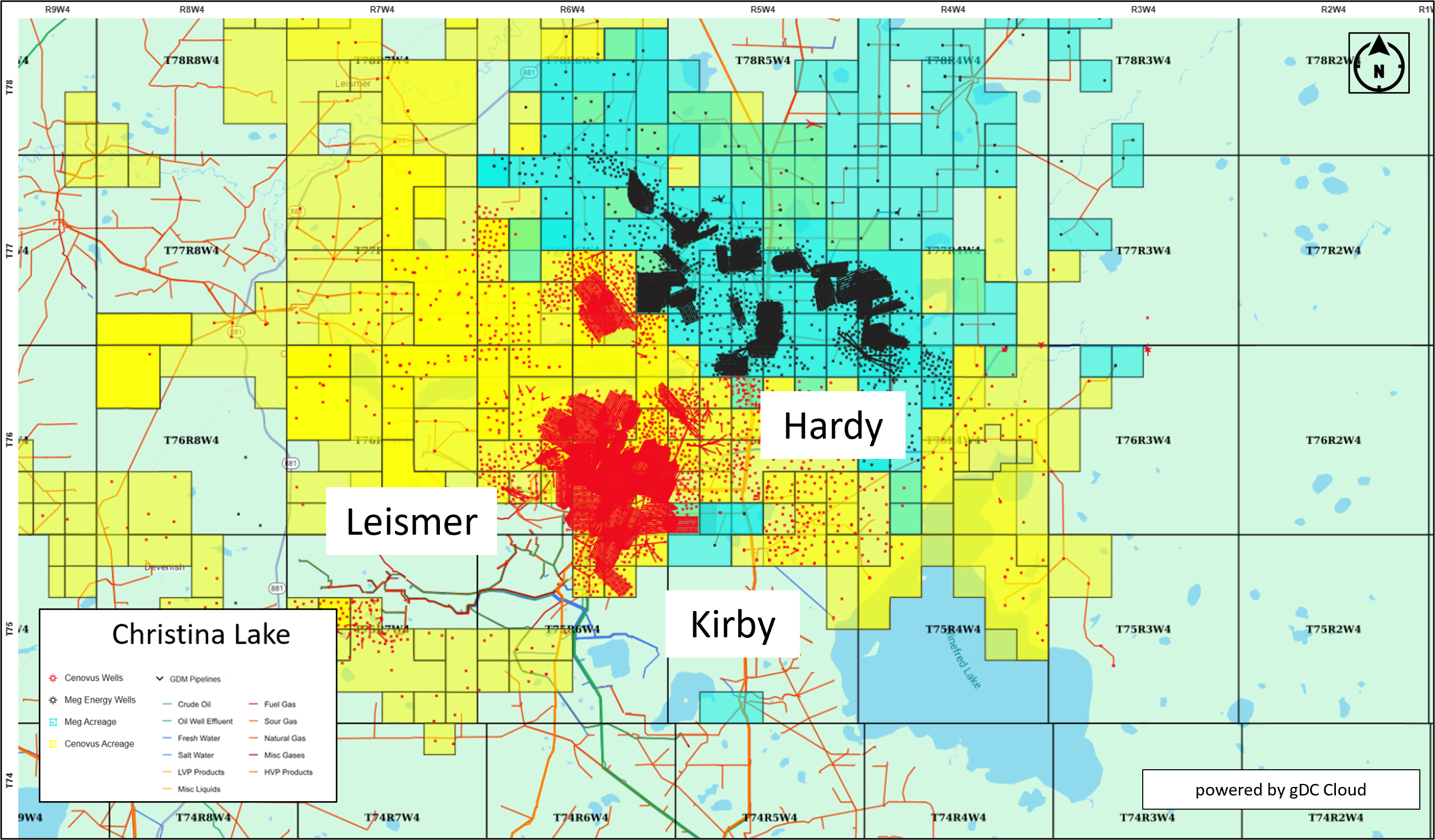
Cenovus has existing resources at Hardy, Winnifred Lake and Leismer located on the other side of the acquired acreage.
Accessing these resources would have required long distance pipelines, and likely wouldn't have come into play for many decades, McKenzie said. With the addition of MEG’s infrastructure, these resources can now be tied into the acquired processing facility much sooner and at a lower cost.
Cenovus can also now access resources within competitive drainage offsets between its existing operations and MEG’s operations.
Development is restricted within 100 metres on either side of the lease boundary, and with that lifted additional resources are available to develop and a more optimal pattern orientation is possible going forward.
New commercial opportunities with MEG’s tidewater access
Approximately $120 million of early savings and revenue boost will come from G&A optimization, IT and procurement savings, and new commercial opportunities.
The commercial opportunities come from MEG’s contracted egress out of the basin. Around 80 per cent of its of blended production has access to tidewater.
This includes 20,000 bbls/d of contracted capacity on the TMX, adding to Cenovus’s 144,000 bbls/d.
MEG also has 100,000 bbls/d of blended bitumen capacity on the Flanagan South and Seaway pipeline systems providing access to U.S. Gulf Coast refineries, along with 500,000 bbls per month of marine export capacity from the docks at Beaumont, Texas.
No plans for Surmont acreage yet
The deal also came with significant undeveloped acreage, including the 32 sq. mile Surmont lease approximately 30 miles north of the Christina Lake project.
MEG conducted extensive seismic and delineation drilling programs at Surmont leading up to its regulatory approval in 2019. But approvals were cancelled at MEG’s request in 2021 as a cost savings measure during the height of the pandemic.
It is adjacent ConocoPhillips Canada’s operations in the area.
While McKenzie announced no immediate plans for Surmont, he hinted it could go on the sales block.
“One of the things that we always do as a company is continuously evaluate our portfolio and we've talked quite openly in the past about some of the assets and the fit within our portfolio.”
“I think with this transaction, it probably heightens our thinking around getting back to shareholder returns of 100 per cent, as well as managing the risk of debt. So, nobody should be surprised if we do find a way to reduce that debt more quickly and get back to 100 per cent shareholder returns a lot sooner than just organically deleveraging.”