TMX North? Exploring New Route Options To Canada’s West Coast
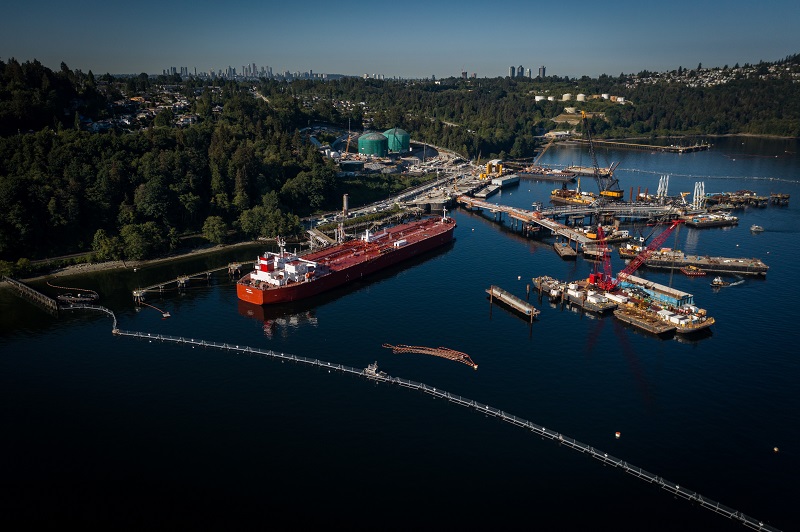
As calls grow for more West Coast export capacity for Canadian crude, could the old idea of a northern leg off the Trans Mountain pipeline extending toward Kitimat or Prince Rupert return to the discussion?
Industry experts say such a route could offer strategic advantages for Canada, but major commercial, political and regulatory hurdles remain.
In a 2009 article published by DOB Energy, a Kinder Morgan Canada senior director said if the company were asked to build to Kitimat, then Trans Mountain could leverage its existing system and extend a 750-kilometre line from Valemount, B.C., to Kitimat as a northern leg. During the 2014 Trans Mountain expansion regulatory process, the company also examined alternative West Coast marine terminal locations, including Kitimat.
The discussion comes as Alberta and Ottawa pursue a broader agreement tied to industrial carbon pricing, the Pathways CCUS project and a possible future West Coast pipeline.
Rory Johnston, founder of Commodity Context and a lecturer at the University of Toronto’s Munk School of Global Affairs and Public Policy, told DOB Energy that a central issue driving current alternative terminal location discussions is that Trans Mountain’s current exit point, through the Port of Vancouver, is too shallow to accommodate the very large crude carrier (VLCC) tanker ships necessary to take full advantage of Asian markets.
“We’re servicing basically medium-sized tankers that can make their way to China, and that trade is developed, but we haven’t been able to establish any long-term durable trade out of the West Coast with India, for example.”
Currently, he said, Canadian oil exporters ship between one and two VLCCs per month to India. However, those are coming entirely out of the U.S. Gulf Coast re-export market because those ports can load VLCCs.
“If we look at the long-term trajectory of Canadian exports, we want to serve those markets from our own ports. We’re going to need deepwater ports capable of loading those vessels.”
In terms of a northern leg to Trans Mountain splitting at Valemount, Johnston added there may be some benefits from parts of the pipeline already being permitted and scoped, although the ultimate concern is establishing deepwater access that can accommodate VLCCs.
“That has big impacts both for the pricing we can get for those barrels because it’s more expensive to ship on smaller tankers, but also just because of the pure economies of scale here.”
The path of least resistance
Dennis McConaghy, a fellow of the Canadian Global Affairs Institute (CGAI) and former executive with TC Energy Corporation, said a northern route similar to the former Northern Gateway proposal may be geographically easier than branching west from Valemount as it avoids mountainous terrain for a greater portion of the route. Coastal GasLink ultimately demonstrated that major energy infrastructure can successfully cross the coastal mountains into Kitimat, he noted.
“It’s really just a question of getting up to the mountains by going further north to begin with. That’s really the point because of the topography. If you just look at it from the way the mountains exist, there is that area south of Grande Prairie across to just north of Prince George and Burns Lake before you actually hit the mountains. That’s what you’re really taking advantage of.”
However, McConaghy noted the pipeline business is often a trade-off between what proponents want to do and what they can do. While he sees the ideal route for a second pipeline to the West Coast as largely corresponding with the proposed line for Northern Gateway, he said finding a compromise that leverages existing routes and infrastructure might be more feasible. That may very well mean another pipe along the current TMX line.
“It does have an advantage in that you’ve already settled with most of the First Nations, or almost all of them, to get TMX done,” he said, adding that while expanding tanker traffic through Burrard Inlet remains politically contentious, the route could leverage existing rights-of-way and First Nations agreements. “You have already proven that you can actually engineer it for the most part.”
The benefits of going south
Despite the potential strategic advantages of additional Canadian Pacific export access, Johnston and McConaghy both stress that any new West Coast pipeline would face significant economic and political realities. In many ways, from a business perspective, expanding south simply makes more sense.
“It’s always been cheaper to go south,” Johnston said. “If left to its own devices without government support, that is the way pipelines would likely develop on a ‘cheapest-per-flowing-barrel basis’ because it maximizes netbacks for producers making these shipping commitments.”
Both Johnston and McConaghy point to Bridger Pipeline LLC’s proposed 550,000-bbl/d expansion to transport Canadian crude from Montana to Wyoming, potentially reviving part of the cancelled Keystone XL concept through a less controversial route, with South Bow Corporation serving as the Canadian partner behind the proposed concept.
“Of course, you’re going through two provinces that have settled land claims; you’re going through two provinces that actually want this development,” McConaghy said, adding that while it does not provide Canadian producers with a direct link to Asian markets, this “KXL 2.0 is an infinitely easier option” for industry.
The proposed Bridger pipeline, effectively a smaller-scale successor to Keystone XL, offers a more straightforward southbound expansion path into existing U.S. markets, he noted. “It’s an easier incremental set of commitments.”
Why West Coast ports matter
Ultimately, Johnston said, the rationale for building another route to the West Coast is less about maximizing day-to-day pricing and more about giving Canada strategic export optionality during periods of increased geopolitical or trade disruption. As a parallel, he highlighted Saudi Arabia and its East-West Pipeline. Built during the Iran-Iraq war in the 1980s, it connected Gulf production to the Red Sea as a hedge against potential Strait of Hormuz closures.
With a seven-million-bbls/d capacity that basically flowed at a third or less of its capacity for most of its life, he noted the value of that strategic infrastructure is now evident as the current conflict with Iran disrupts Gulf egress. It shows a strategically important pipeline could effectively pay for itself during a major geopolitical or trade crisis.
Johnston added: “If [a similar] pipeline was built in Canada 50 years ago by the government, then you would have seen industry or political commentary being like ‘it’s a government boondoggle, it’s a waste of money,’ and then all of a sudden, boom, it’s extremely valuable.”